


25 Nov The City Inside the Cell: An Insight Into God’s Majesty
Inside every one of your cells is a working city: gates, a records office, workshops and power plants. Scripture did not need a microscope to call you wonderfully made, but the microscope gives those words more weight.
This is the first post in our Science and Majesty lane. The rule for this lane is simple. Science describes what is there. Scripture tells us whose it is. We will keep the two in their places and let the first invite us toward the second. Scripture quotations are from the World English Bible.
Trillions of small worlds
The National Library of Medicine describes the human body as made of trillions of cells. Each one is too small to see without help. Each one is alive, and each one is busy. You are reading this sentence because trillions of them are doing their jobs at the same time.
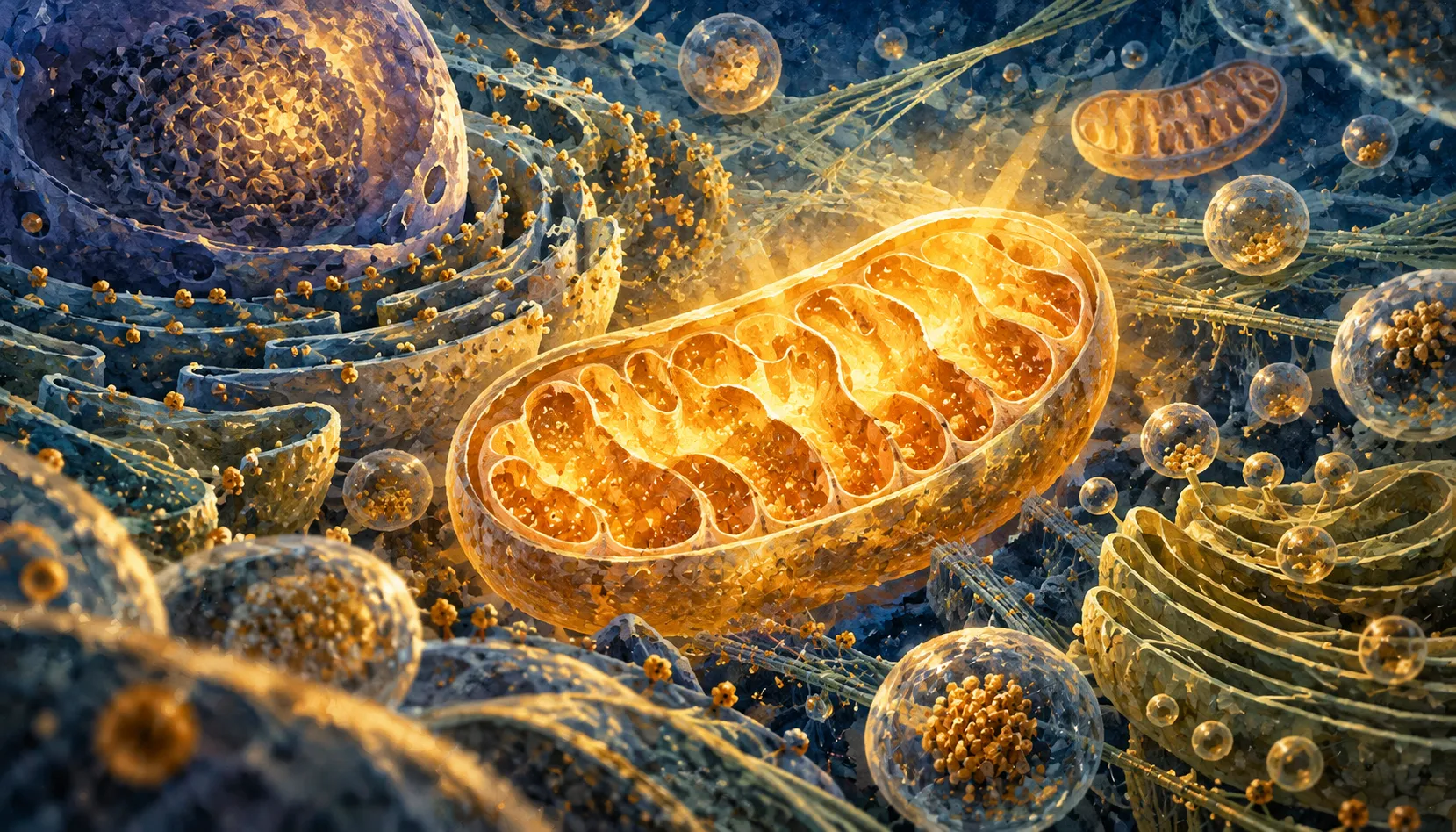
A cell has an outer boundary called the plasma membrane. It decides what comes in and what goes out, like a city wall with guarded gates. Inside sits the nucleus, which the same source calls the control hub. It holds the DNA and directs growth, division and death. Ribosomes read the genetic instructions and build proteins. Think of a records office that also runs the workshops.
Nothing on that list is decorative. Every part has a job, and the jobs depend on one another. Hidden does not mean simple. It usually means the opposite.
Mitochondria and the energy of a city
Every city needs power. In the cell, that work belongs to the mitochondria. The National Human Genome Research Institute describes them as the organelles that produce most of the chemical energy a cell needs. That energy is stored in a molecule called ATP, which then drives the other reactions in the cell.
A few details are worth slowing down for. Mitochondria have two membranes, which is unusual for an organelle. Britannica notes that the inner membrane is folded into ridges called cristae, and that the main energy-generating system of the cell sits on those folds. Each mitochondrion is tiny, about half a micrometer to ten micrometers across. A single cell can hold hundreds or even thousands of them. Cells that need more energy, such as muscle, liver and kidney cells, carry more. Red blood cells carry none at all.
Mitochondria also carry their own small set of DNA, separate from the DNA in the nucleus. The National Library of Medicine puts it at about 16,500 base pairs holding 37 genes. Thirteen of those genes give instructions for the enzymes of oxidative phosphorylation, the process that uses oxygen and simple sugars to make ATP. This is one reason you breathe. The air you took in a moment ago is being spent right now, in these small folded chambers, to keep you alive.
Knit together in secret
David did not know about mitochondria. He knew something else, and he knew it well enough to sing it.
For you formed my inmost being. You knit me together in my mother’s womb. I will give thanks to you, for I am fearfully and wonderfully made. Your works are wonderful. My soul knows that very well. (Psalm 139:13-14)
Notice the order of the Psalm. First comes the fact: God formed and knit. Then comes the response: thanks. David does not analyze the knitting. He thanks the one who did it. A verse later he says his frame was not hidden from God when he was made in secret and woven together (Psalm 139:15). The hidden places were never hidden from the maker.
Paul adds the wider frame. Speaking of Yeshua, he writes that all things were created through him and for him, and that in him all things are held together (Colossians 1:16-17). The cell’s order is not an argument we win. It is a place where we bow.
What this does and does not say
We need to be careful here. This post does not claim that science proves God. A biologist who does not believe can describe the same mitochondrion, with the same numbers, and go home unmoved. The microscope shows order. It does not hand out faith.
What Scripture says is narrower and stronger. The invisible things of God are perceived through the things that are made (Romans 1:20). That is a statement about creation inviting worship, not a laboratory result. The believer does not bring new data to the cell. The believer brings a lens, and through that lens the cell looks like what Psalm 139 already said it was.
So the question to ask at the microscope is not “does this prove anything?” The better question is “what does this invite me to do?” Psalm 139 answers plainly: give thanks.
A practical response
Wonder that stays in the head fades by Friday. Here are four small ways to let it reach your hands and your mouth this week.
Read Psalm 139:13-16 out loud once a day. Slow down on the word “wonderful.” Let it be about God’s work before it is about you.
Before one meal each day, remember that the food on the plate will become ATP in the city inside you. Say thank you before you eat, and again when you notice you have energy for the afternoon. If you want a simple form for that pause, our post One Minute Before the Lord gives one.
Learn one true thing about the cell from a reliable source, such as the pages linked below. Then tell one person, a child, a friend or a coworker, and end with the Psalm rather than the fact.
Pray for one person whose body is failing. The National Human Genome Research Institute notes that defects in mitochondrial pathways can cause symptoms in the muscles, brain and kidneys. The God who knit the cell together also meets the people whose cells are breaking. Hold them before Him by name.
A prayer for the hidden places
Father, we thank You for the things we cannot see. We thank You for trillions of cells doing work we never asked for and could never manage. We thank You that nothing in us was hidden from You when we were made in secret. Forgive us for treating our bodies as ordinary. Teach us to receive each day of energy as a gift from Your hand. Hold together, through Yeshua, the people whose bodies are failing, and hold us together too. We give You thanks, for we are fearfully and wonderfully made. Amen.
Sources on this topic include What is a cell? (MedlinePlus Genetics, National Library of Medicine), Mitochondria (National Human Genome Research Institute), Mitochondrial DNA (MedlinePlus Genetics) and Mitochondrion (Britannica). Pages can change, so check the current version.
The city inside the cell
It is a picture, not a technical term. A cell has a guarded boundary, a control hub that holds its records, workshops that build proteins, and power plants called mitochondria. Those parts depend on one another the way the parts of a city do.
We do not make that claim. Scripture says the invisible things of God are perceived through what is made, which is an invitation to worship rather than a proof. The cell shows order, and the believer sees that order through the lens of Psalm 139.
They convert energy from food into ATP, the form of energy the cell can use, in a process that needs oxygen. A single cell can hold hundreds or thousands of them, and they carry a small set of their own DNA with 37 genes.
Psalm 139 says God formed our inmost being and knit us together in secret. The cell is one of those secret places. The Psalm also models the right response to what we find there, which is thanks rather than analysis.
No Comments